
What Happened To Chief Biggy?: corruption, crime, and a cold case in early twentieth century San Francisco
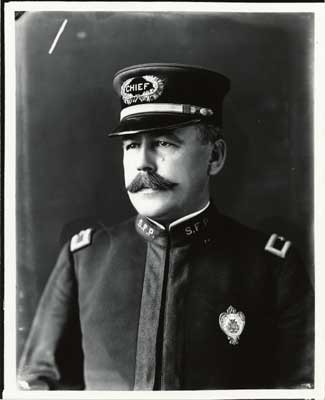
On the cold foggy night of November 30, 1908, Chief of Police William J. Biggy went missing shortly before midnight from a police patrol boat in the San Francisco Bay. Mostly decomposed and unrecognizable, his body was found floating in the channel between Yerba Buena Island and Lombard Street Warf a few weeks later. The body was identified by family through personal effects and clothing.[1] The sad ending for Chief Biggy is one of many unsolved cold cases in San Francisco’s history. In Biggy’s day, the city was ruled by corrupt city bosses, vice, and greed. The events surrounding the Chief’s death marked a turning point for San Francisco.
Since it was taken over by Americans in 1846 and gold was discovered within its veins, the San Francisco Bay Area was a picture of crime and lawlessness often characterized as the wild west. The population of the region grew rapidly, a rush of men who came to strike it rich. Local government was venal or weak and violent crime so common place that citizens created the Vigilante Committee to try to bring order. Their method included an extemporaneous trial and public hanging aimed to instill fear and prevent violence. For more than 50 years, gambling and prostitution wreaked havoc on the young town.[2] By the beginning of the twentieth century, San Francisco had begun to feel the effects of eastern prohibitionists and puritans.[3] The last powerful city boss, Abe Ruef, founder of the Union Labor Party in 1901, and his corrupt administration, including Mayor Eugene Schmitz, were indicted in 1906 for bribery and extortion. Ruef’s political machine controlled judges, the Board of Supervisors, and the Chief of Police. Yet his endorsement of District Attorney William Langton would be his demise. Langton enforced the city’s vice laws and attacked brothels and gambling dens. Ruef would not go down easy as executions of arresting officers and the attempted assassination of Francis Heney, the federal prosecutor proved.[4] It is in this story that William Biggy lost his life.
In 1907 William Biggy, a devout Catholic and known to be an honest man, was appointed by Mayor Edward Robeson Taylor to replace Chief of Police Jeremiah Dinan, who was forced to resign under charges of perjury. Biggy made himself known as an Officer of the Court during Ruef’s trial as he was tasked with guarding the prisoner in the St Francis Hotel. The jails had been corrupted by Dinan and Ruef was a known charmer who endeared and paid officers to do his bidding. The honest Biggy, however, was trusted to guard him away from sullied city jails. Sadly, in this corrupt climate, even Biggy’s name would be tarnished. While on trial, Morris Haas, Ruef’s bagman, took out a gun and fired on prosecutor Heney, who survived the bold attack. Haas, however, did not. He was later found dead in his cell, shot in the head with a .22 pistol, which oddly was discovered in his shoe. Rumors flew and newspapers charged that Biggy, who had been corrupted while watching Ruef at the St. Francis, was on Ruef’s payroll and ordered Haas killed so he could not talk about the attempt on Heney’s life. Although he adamantly denied the allegations, Biggy wanted to resign until he cleared himself of the unofficial charges. Police Commissioner Hugo Keil, however, convinced Biggy that resigning would be viewed as a confession and so he stayed on. The two continued to discuss the investigation into Haas’ death, until one night when Chief Biggy himself fell victim to the corruption that plagued the city.[5]
On the night of Novemeber 30, 1908, Chief Biggy and Commissioner Keil met at Keil’s home in Belvedere, a residential area of Tiburon across the bay from the city, to talk about the investigation. About 11 o’clock that night, Biggy left Keil’s home, boarded the police patrol boat and headed back across the bay for the city. Police officer and patrol boat driver, William Murphy, was the only other occupant on the boat. The two men chatted awhile during the first leg of the journey until Biggy complained of being cold. Murphy advised him to seek shelter beneath until the boat docked and at that point Murphy went back to manning the wheel. He last saw Biggy leaning against the rail as they passed Alcatraz Island. When the boat docked, Biggy was no longer on board.[6] A search party organized and for three days divers and hikers relentlessly hunted for their Chief of Police with no avail. On December 15th, a few weeks later, Biggy was found floating in the bay. Even though the coroner found no clear marks of foul play, it was hard to swallow that Biggy would have committed suicide. Not only was he a devout Catholic but Keil explained that Biggy left his house in a cheerful mood. In addition, a fully loaded hammerless revolver was found in his pocket. While some doubted the suicide theory, others embraced it, believing that Biggy had been corrupted by Ruef and was unable to face the impending charges against him over Haas’ mysterious death.[7] Two years later however, more began to believe that Biggy had been murdered after Murphy was committed to a mental institution and said to have exclaimed repeatedly, “I don’t know who did it, but I swear to God I didn’t.”[8] Whether guilt, fear or both caused Murphy’s mania, the mysterious death of William Biggy marked the end of city bosses, lawlessness, and corruption going unchecked in San Francisco. While the unexplained death of Chief Biggy remains an open case, the shady sin and corruption that afflicted the city were closed.
[1] “Biggy’s Body Found in Bay,” Sacramento Union, (Sacramento, CA) December 16, 1908
[2] Richard B. Felson, and Patrick R. Cundiff. “The Gold Rush and Afterwards: Homicide in San Francisco, 1849-2003.” Aggressive Behavior 44, no. 6 (2018): 601-613.; Nancy J. Taniguchi, “Weaving a Different World: Women and the California Gold Rush,” California History 79, no. 2 (2000): 141-68.
[3] “Abe Ruef: America’s Most Erudite City Boss,” The Museum of the City of San Francisco, http://www.sfmuseaum.net/hist1/ruef/html
[4] Walton E. Bean, “Boss Ruef, the Union Labor Party, and the Graft Prosecution in San Francisco, 1901-1911.” Pacific Historical Review 17, no. 4 (1948): 443-55
[5] “Unsolved Death of Chief William Biggy,” Museum of the City of San Francisco, http://www.sfmuseum.org/sfpd/sfpd1.html
[6] “San Francisco Chief of Police Drowns in Bay,” Los Angeles Herald, Volume 36, Number 61, 1 December 1908, https://cdnc.ucr.edu
[7] “Unsolved Death,” Museum of the City of San Francisco
[8] “Streets of San Francisco,” San Francisco Chronicle, September 19, 1928, 7.
 Northern California History
Leave a comment